
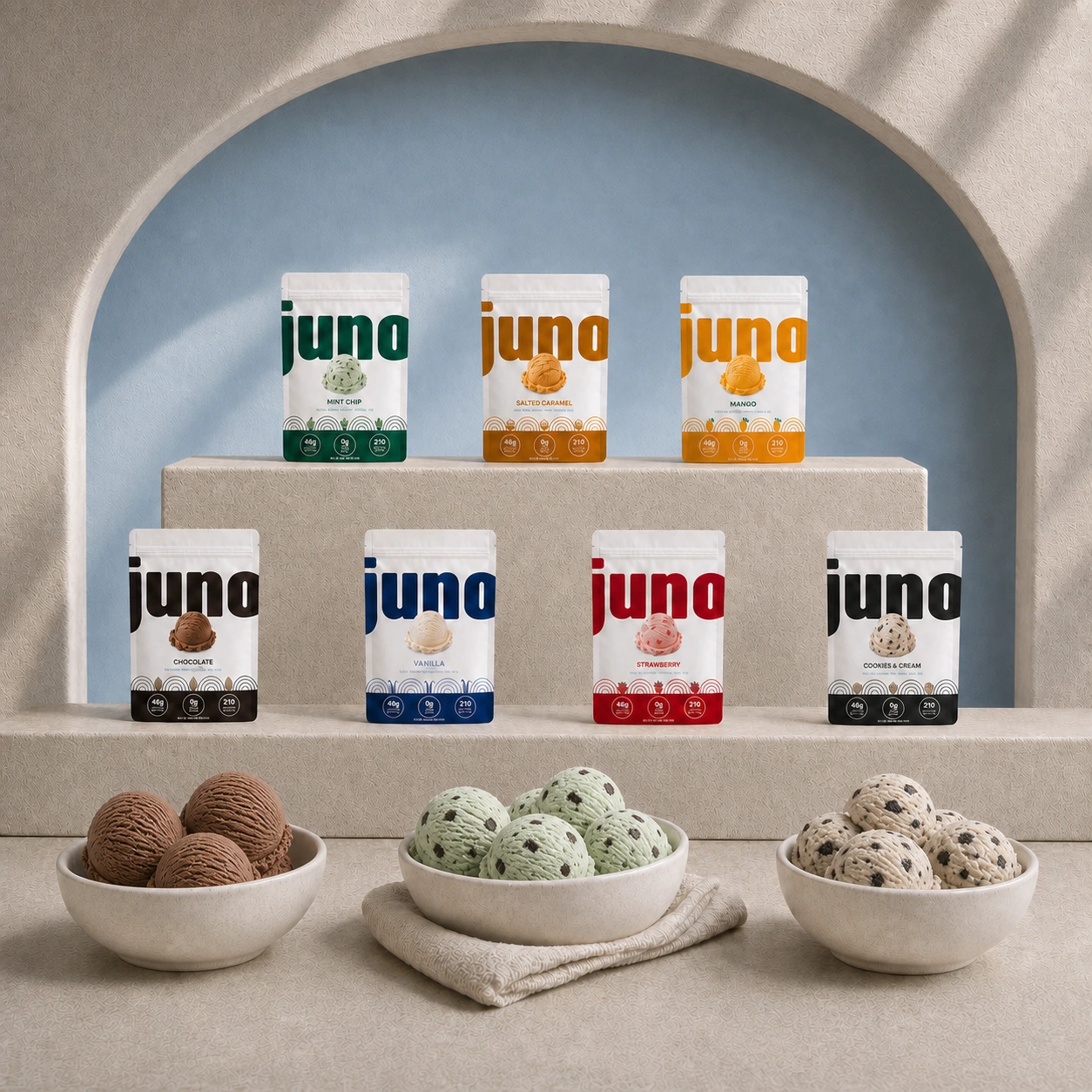
Freeze a Ninja CREAMi pint until it is completely solid from edge to center. For many official Ninja recipes, that means at least 24 hours. Juno Chocolate's current preparation directions specify at least 16 hours. When the product and appliance give different minimums, use the longer instruction—and remember that a clock cannot tell you whether the middle of a pint is actually frozen.
Twenty-four hours is the simplest conservative default. A level, fully solid pint matters more than racing the timer.
The short answer: 16 hours or 24 hours?
| Situation | Minimum to follow | Why |
|---|---|---|
| Official Ninja recipe | The recipe's stated time, commonly 24 hours | That recipe was written for that base and program. |
| Juno Chocolate with 2% milk | At least 16 hours | That is Juno's current product direction. |
| Conflicting instructions | The longer time | It is the more conservative way to satisfy both directions. |
| Pint is still soft in the center | Keep freezing | Elapsed time does not override the physical condition of the base. |
Four checks before you process
- The base is frozen through. The surface should be firm, not slushy, and the center should not move when the pint is gently tilted.
- The top is level. Freeze on a flat shelf and follow your machine's instructions if the surface freezes at an angle or develops a pronounced mound.
- The pint stays below its maximum fill line. Freezing does not make an overfilled container acceptable.
- Your model allows the planned program. CREAMi models and containers differ. Use the owner's guide for the machine in front of you.
Why two identical pints can freeze differently
Freezer setting, shelf position, airflow, pint temperature when it entered the freezer, container size, and the base itself all affect the time required. Sugar, fat, dissolved milk solids, and other ingredients also change how hard a mixture freezes. That is why “overnight” is useful shorthand, not a guarantee.
The U.S. Food and Drug Administration recommends keeping the freezer at 0°F (-18°C). A small appliance thermometer can confirm the actual temperature; the dial setting is not a measurement.
A repeatable freezing routine
- Mix the base thoroughly and scrape the bottom corners.
- Put the lid on and label the pint with its flavor and freeze time.
- Place it upright on a level shelf with room for cold air to circulate.
- Use 24 hours as the conservative planning window unless your exact recipe and appliance say otherwise.
- Check that it is solid and level, then process immediately after removing it.
Make tomorrow's pint while cleaning up tonight's. A consistent daily freeze time removes one variable from texture troubleshooting.
Does freezing longer always improve texture?
No. Once the pint is fully frozen and temperature-stable, another day does not repair a poorly balanced base. If a reliably frozen pint is icy, look at its ingredient balance and processing steps. If the first spin is dry or crumbly, use Re-Spin—not Mix-In—before rewriting the recipe.
Quick answers
Can I process after 8 or 12 hours?
Not when the applicable recipe calls for 16 or 24 hours. A partially frozen pint is not the intended starting condition.
Can I freeze a pint for several days?
Yes, if it remains properly covered and frozen. Longer storage can make surface ice or freezer odors more likely, so keep the lid sealed.
What if the first spin is powdery?
That does not prove the pint froze too long. Follow our powdery-pint troubleshooting order.
Sources and scope
Official Ninja Test Kitchen protein ice cream recipes instruct users to freeze for 24 hours and use Re-Spin when needed; see the Chocolate Protein Ice Cream recipe. Freezer temperature guidance comes from the FDA's food-storage guidance. Juno's 16-hour minimum applies to the current verified Chocolate directions. Juno is not affiliated with or endorsed by SharkNinja.