
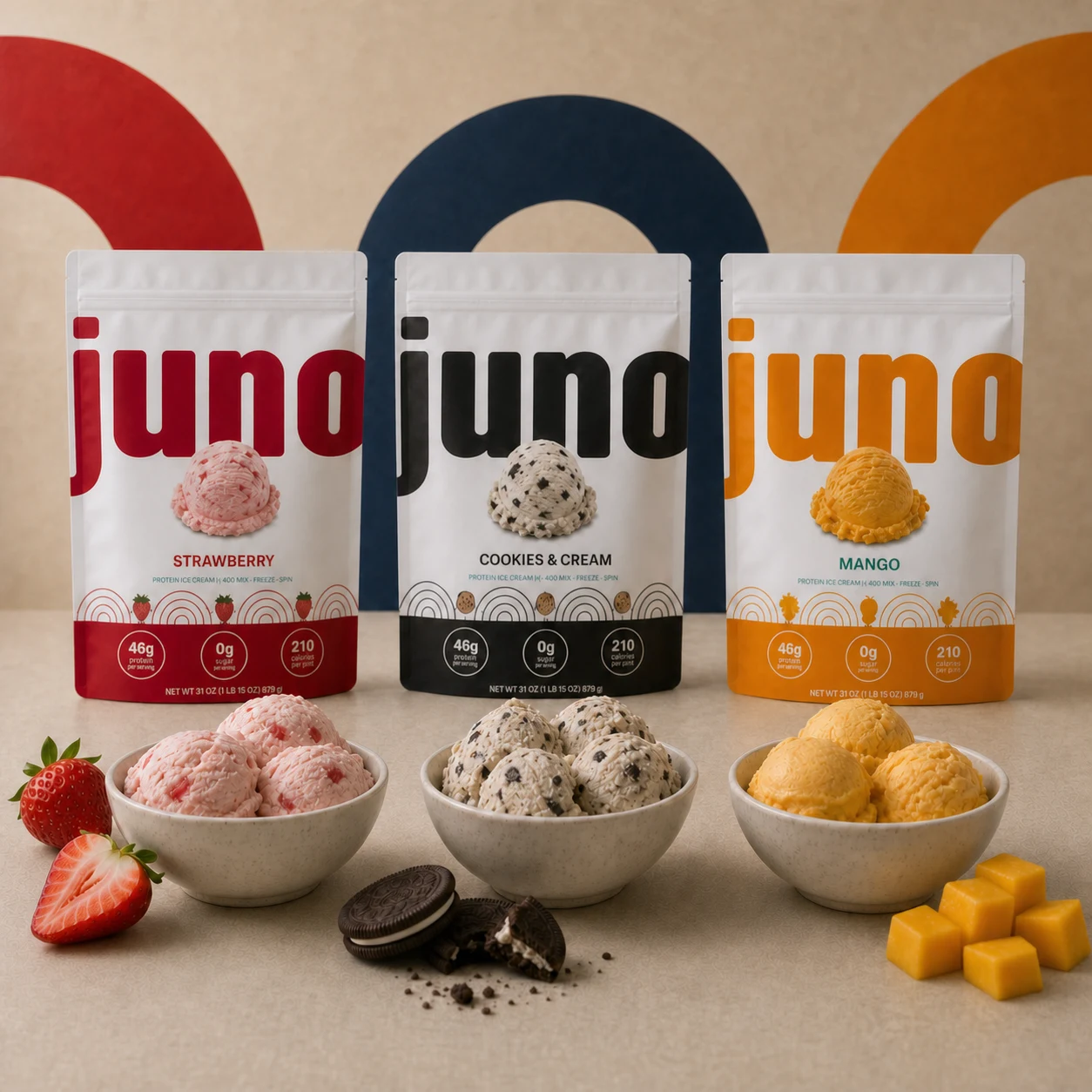
There is no universal protein-ice-cream ratio that works for every powder and liquid. The useful approach is to balance six jobs: water provides the frozen phase; protein and milk solids add body; fat and sugar affect richness and softness; stabilizers control water movement; flavor ingredients add their own solids and water. A reliable ratio is a complete formula, not “one scoop plus some milk.”
A verified starting ratio
For the current Juno Chocolate formula, the verified preparation is 88g Juno Chocolate mix to 1¼ cups 2% dairy milk. That is about 70g of dry mix per cup of milk, but it should not be generalized to ordinary protein powders: Juno's dry mix also contains sweetener, nonfat dry milk, cocoa, salt, and stabilizer.
Use an established recipe exactly once before adapting it. If you start from an untested powder, its label and ingredient list matter more than a ratio copied from a different product.
The six-part balance
| Part | What it contributes | What can go wrong |
|---|---|---|
| Liquid and water | Volume and the frozen structure | Too much unbalanced water can taste icy or weak. |
| Protein | Nutrition, body, water binding, dairy flavor | Too much can become chalky, dense, gummy, or brittle. |
| Other milk solids | Body and dairy flavor without adding only protein | Excess solids can make the base heavy. |
| Fat | Richness, lubrication, flavor delivery | Very lean bases have less margin for a creamy perception. |
| Sugar and sweeteners | Sweetness and, depending on the ingredient, freezing behavior | A sweetener swap can change both taste and hardness. |
| Stabilizers and flavor solids | Water control, suspension, cocoa or fruit character | Small changes can create gumminess, dryness, or excess water. |
How to adapt a working formula
- Record the control. Weigh every ingredient and note the milk, freezer temperature, freeze time, program, and spins.
- Choose one goal. More protein, fewer calories, stronger flavor, or a dairy-free liquid are separate experiments.
- Change one variable. Keep everything else—including processing—the same.
- Score the same attributes. Compare scoopability, iciness, chalkiness, gumminess, sweetness, flavor, and melting.
- Repeat the winner. One good pint may be luck; a repeated result is a more useful formula.
Common ratio traps
Replacing milk with water
This removes milk fat, protein, lactose, and other solids at once. It is not a one-variable substitution even when the volume stays equal.
Adding fruit by volume
Fruit adds water, sugar, acid, fiber, and flavor. Frozen fruit, purée, and freeze-dried fruit behave differently, so record the form and weight.
Doubling protein powder
The pint gains more than protein. It also gains every gum, sweetener, and flavor in that powder. Learn more in protein ice cream mix versus protein powder.
Assuming all dairy protein is interchangeable
Whey and casein ingredients can change viscosity, aeration, hardness, melting, and sensory properties. Those effects depend on the complete formulation. Our whey-versus-casein guide separates the evidence from the shortcuts.
A simple test card
- Ingredient names, brands, and weights
- Total liquid volume and pint size
- Freezer temperature and total freeze time
- Machine model and program
- Number of Re-Spins and any added liquid
- Texture immediately, after five minutes, and after refreezing
This method is slower than guessing for one pint and much faster than guessing for ten.
Sources and scope
The Juno ratio and nutrition statements apply only to the verified current Chocolate product and specified preparation. The broader formulation discussion is consistent with published frozen-dessert research showing that protein source affects viscosity, overrun, hardness, melting, microstructure, and sensory results; see The Use of High-Protein Preparations in Ice Cream Production and Microstructural and Physical Properties of High-Protein, High-Overrun Frozen Desserts. These studies use their own formulations and production methods; they do not prove a universal home-machine ratio.