
Whey and casein can both work in protein ice cream, but neither is automatically creamier. Controlled frozen-dessert studies show that protein source changes viscosity, air incorporation, hardness, melting, microstructure, and sensory perception. The direction and size of those changes depend on the ingredient form and the complete formula.
Why the easy answer is misleading
“Whey” can mean concentrate, isolate, or a specially processed ingredient. “Casein” can mean micellar casein concentrate, sodium caseinate, or the casein naturally present in milk. Each comes with different mineral, lactose, fat, and processing histories. Comparing brand-name powders also compares their sweeteners, flavors, lecithin, and gums—not only their proteins.
What the proteins tend to change
| Property | Why it matters in a frozen dessert | Why there is no universal winner |
|---|---|---|
| Hydration and viscosity | Affects mixing, body, and how air and water are managed | Protein concentration, heat treatment, minerals, and stabilizers all interact. |
| Air incorporation | Changes density and perceived lightness | A home CREAMi does not freeze and whip like a continuous commercial freezer. |
| Hardness and brittleness | Affects scoopability and first-cycle texture | Sugar, fat, total solids, and storage temperature also control firmness. |
| Melting | Affects drip, shape retention, and mouthfeel | Fast or slow melting is not automatically better. |
| Flavor | Protein ingredients can contribute dairy, cooked, sour, or mineral notes | Flavor systems and ingredient quality can mask or amplify those notes. |
What controlled studies found
A 2025 ice cream study compared micellar casein concentrate, buttermilk protein concentrate, whey protein concentrate, and a skim-milk-powder control in defined formulas. The whey-protein-concentrate version in that experiment had the highest hardness, lowest overrun, fastest melting, and weaker sensory scores. That is a useful result for those formulas—not proof that all whey protein makes hard, poor ice cream.
A separate controlled frozen-dessert study compared milk protein concentrate, sodium caseinate, and whey protein isolate at the same headline protein level. It found protein-specific differences in microstructure and physical behavior, reinforcing the broader conclusion: the source and structure of the protein matter.
What this means for a home CREAMi
- Test products, not category slogans. Compare exact powders by weight in an otherwise identical formula.
- Keep total protein and total solids visible. Equal scoops rarely mean equal grams or composition.
- Record processing. A pint needing two Re-Spins should not be scored as if it needed none.
- Score flavor and texture separately. The smoothest sample may not taste best.
- Repeat the result. Freezer variation can overwhelm a small formula difference.
Where Juno Chocolate fits
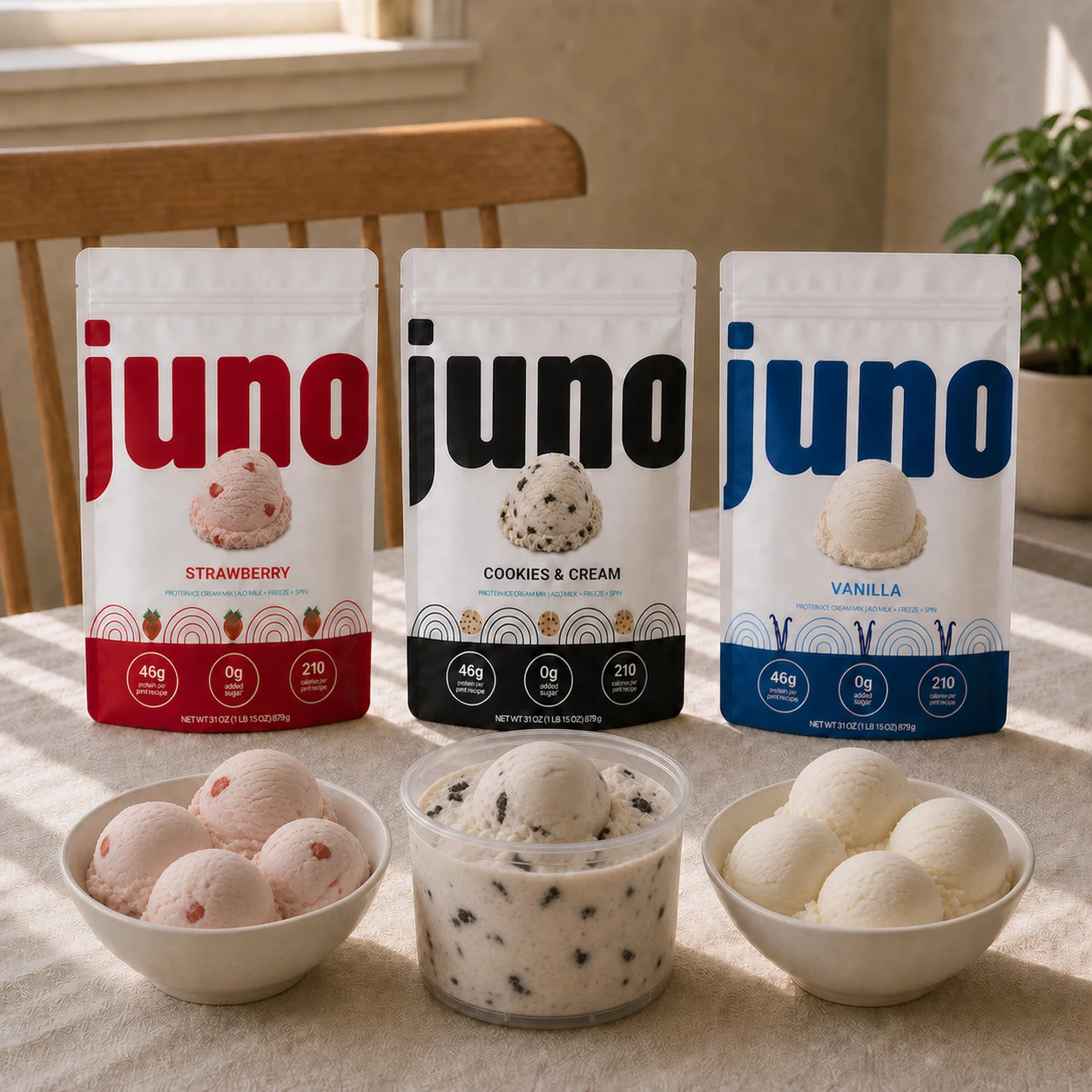
The current verified Juno Chocolate formula uses whey protein concentrate alongside nonfat dry milk, plus allulose, cocoa, monk fruit, salt, and guar gum. Its result therefore cannot be credited to whey alone. The other solids, the 2% milk, their ratio, and the processing directions are part of the system.
Should you blend whey and casein?
A blend can be a sensible experiment because milk naturally contains both protein families and mixed systems can combine functional traits. But “blend” does not specify a ratio, ingredient type, total solids, or stabilizer system. Start from a working control and change the protein system by weight while holding everything else as steady as possible.
Choose a complete formula that tastes and processes well. Use whey-versus-casein as a testable formulation question, not a shortcut that predicts the pint from the front of a protein tub.
Sources and scope
Primary research: The Use of High-Protein Preparations in Ice Cream Production compared four protein preparations in experimental ice creams; Microstructural and Physical Properties of High-Protein, High-Overrun Frozen Desserts compared three dairy-protein systems; and a microparticulated whey study shows that processing and microstructure can change functional results. These are controlled research systems, not tests of Juno or a Ninja CREAMi.