
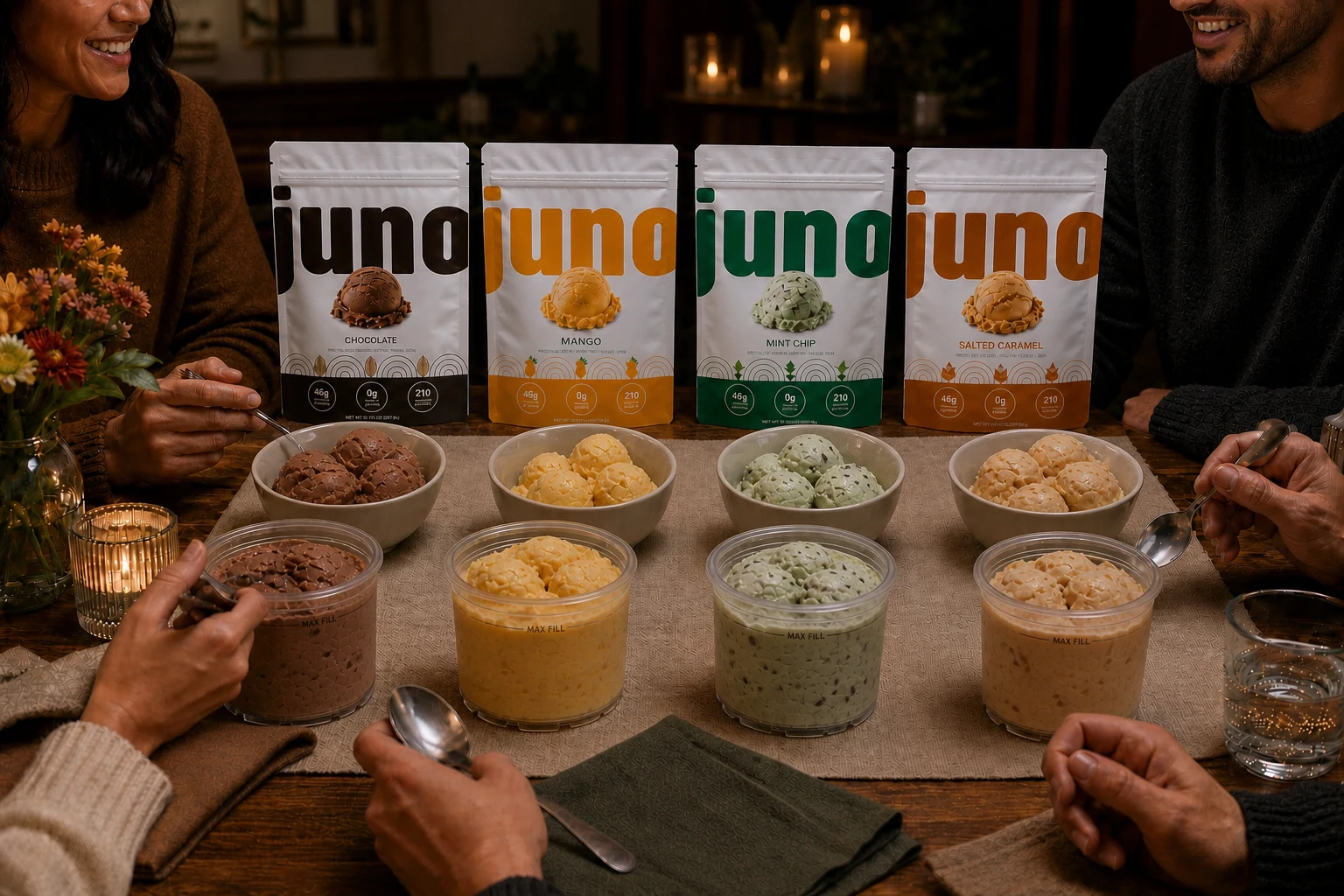
Freezer temperature should change how firm a base is when it enters the machine, which may change the first-cycle texture and the need for Re-Spin. But Juno has not yet published controlled batch results. This page documents the protocol we will use so the eventual result can be audited instead of reverse-engineered from a conclusion.
Status: protocol published; experiment and results not yet published.
The question
When the formula, pint, freeze time, and processing program stay constant, does the measured temperature of a home freezer materially change:
- the pint's center temperature before processing;
- the appearance after the first processing cycle;
- the number of Re-Spins required;
- immediate creaminess, iciness, and scoopability;
- melting behavior over ten minutes?
The test design
| Variable | Plan |
|---|---|
| Formula | One production lot of the verified Juno Chocolate formula, 88g mix and 1¼ cups 2% milk per pint |
| Containers | Matching clean pints from the same machine system |
| Mixing | Same tool, duration, and resting time for every base |
| Freeze duration | 24 hours for every test pint |
| Temperature | At least three verified freezer conditions within normal home-freezer operation, including the FDA-recommended 0°F (-18°C) point |
| Replication | At least three pints per condition, with positions rotated |
| Processing | Same machine, blade assembly, program, and rest time before processing |
| Scoring | Blinded texture scores plus measured temperature, mass, Re-Spins, and melt spread |
What must stay constant
- Weigh the mix and milk rather than relying only on scoops and cup marks.
- Use milk from the same container and record its starting temperature.
- Mix every pint for the same duration and scrape the same way.
- Randomize pint labels so tasters do not know the freezer condition.
- Confirm actual freezer temperatures with calibrated or cross-checked thermometers.
- Process in a randomized order so machine warming does not favor one group.
The scorecard
Each pint will receive the same recorded observations:
- Freezer air temperature range over 24 hours
- Surface and center temperature immediately before processing
- First-cycle texture: powdery, crumbly, smooth, wet, or icy
- Number of Re-Spins and any added liquid
- Blind 1–5 ratings for creaminess, iciness, chalkiness, flavor, and scoopability
- Photographs under fixed light immediately and after ten minutes
- Melt-spread diameter after ten minutes on the same plate type
What the test will not prove
One chocolate dairy formula cannot prove the ideal temperature for every recipe, protein source, plant milk, pint size, or CREAMi model. It can reveal whether temperature has a repeatable effect in this defined system and produce a method others can adapt.
It also will not replace food-safety guidance. The FDA recommends keeping a freezer at 0°F (-18°C). Any warmer comparison must remain within safe operation and will not be presented as a storage recommendation.
How results will be published
When the batches are complete, this page will receive the raw condition table, sample sizes, medians and ranges, representative photographs, deviations, and a dated conclusion. Failed or ambiguous results will remain in the report. Until then, any statement that a specific temperature produces the “best” Juno pint would be an estimate, not a finding.
It prevents the method from quietly changing after we see the outcome, and it gives readers a clear line between a plausible explanation and measured evidence.
Sources and scope
The storage reference point comes from the FDA's recommendation to keep freezers at 0°F (-18°C). Official CREAMi workflow and Re-Spin descriptions come from SharkNinja. This is a prospective Juno test plan, not a completed study or a claim about every machine.