
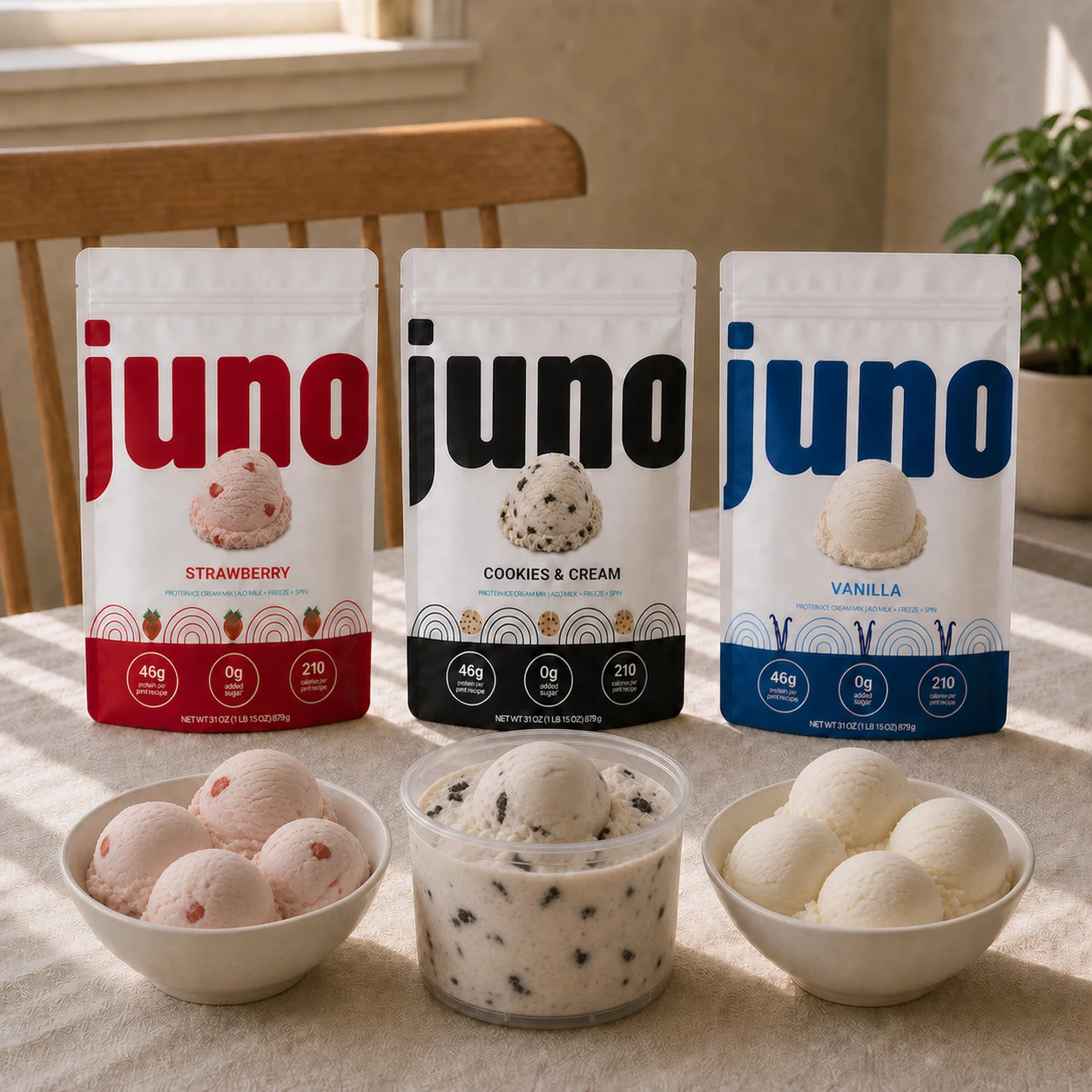
For Juno Chocolate, 2% dairy milk is the best starting choice because it is the milk used for the verified preparation and nutrition. Whole milk usually moves a dairy recipe richer; skim milk usually moves it leaner and firmer. Plant milks can work, but they are not equivalent substitutions because protein, fat, carbohydrate, and stabilizers vary widely.
This is a decision guide based on composition and Juno's verified reference preparation—not a claim that Juno has completed a controlled test of every milk below.
Milk choices at a glance
| Milk | Likely direction | Best for | Watch for |
|---|---|---|---|
| 2% dairy | Balanced creaminess and predictable processing | Juno's reference result | Contains dairy |
| Whole dairy | Richer, softer, higher-fat result | Maximum dairy richness | Changes calories and fat |
| Skim dairy | Leaner and potentially firmer or icier | People prioritizing lower fat | May need a Re-Spin |
| Lactose-free dairy | Often similar to the matching dairy fat level | People avoiding lactose, not milk protein | Can taste sweeter; still contains milk |
| Unsweetened soy | More body than many plant milks | A higher-protein plant-milk experiment | Brand formulas and soy allergens vary |
| Oat | Can add body and cereal sweetness | A creamier plant-milk profile | Carbohydrate, oil, and added sugar vary |
| Unsweetened almond | Lighter, with more free water and less protein | A lighter experiment | Greater risk of a firm or icy pint |
Why 2% milk is the Juno reference
The verified Chocolate preparation uses one serving of Juno—2 scoops or 88g—with 1¼ cups 2% milk. That finished serving has 360 calories and 46g protein. Using a different milk means the published prepared nutrition no longer applies.
Two-percent milk contributes water, dairy protein, lactose, fat, and milk solids. Changing the milk changes several variables at once, even when the volume stays at 1¼ cups.
How to choose for your goal
Most predictable Juno pint
Use 2% dairy milk and the exact amount on the pouch. This is the only choice tied to Juno Chocolate's verified prepared nutrition.
Richer texture
Whole milk is the simplest controlled experiment. Keep the volume constant and expect a different calorie and fat total.
Lower-fat dairy pint
Skim milk keeps dairy protein but removes most milk fat. Expect a firmer freeze and be prepared to use Re-Spin.
Lactose-conscious, but not dairy-free
A lactose-free dairy milk with the same fat percentage is the closest compositional starting point. It still contains milk proteins and is not suitable for a milk allergy.
Plant-milk experiment
Start with an unsweetened product, keep the volume unchanged, record the exact brand, and expect to adjust after one controlled batch. Soy often contributes more protein and body than almond milk, while oat milk often contributes more carbohydrate and may contain added oil.
Using plant milk does not make Juno dairy-free. Juno Chocolate contains whey protein concentrate and nonfat dry milk. Always use the final pouch—not this guide—for ingredient and allergen decisions.
A fair way to compare two milks
- Use the same flavor and dry-mix weight.
- Use the same liquid volume.
- Mix both bases for the same amount of time.
- Freeze the pints side by side on the same level shelf.
- Use the same machine, program, and processing order.
- Record texture after the first spin and after one Re-Spin.
- Compare flavor, creaminess, iciness, scoopability, and nutrition separately.
How to recalculate nutrition
Start with Juno Chocolate's dry-mix values—210 calories and 36g protein per 88g serving—then add the nutrients for the exact amount of milk used. The carton is the controlling source for a packaged milk. For general food-composition research, the USDA maintains FoodData Central.
Do not keep Juno's published “prepared” nutrition when changing the milk. The difference is often meaningful, especially for calories, protein, fat, carbohydrate, and total sugar.
Bottom line
Use 2% dairy milk when you want the Juno result and nutrition as published. Choose whole milk for a richer experiment, skim for a leaner dairy experiment, and plant milk only when you are comfortable treating the batch as a new formula.
Sources and scope
Juno-specific values come from the verified Chocolate production label. General nutrition research can be checked through USDA FoodData Central. Results vary by milk brand and CREAMi model; this page does not replace either package label.